Sub-Zero Ice Maker Repair
What a Bad Cube Tells You About a Sub-Zero Ice Maker in Newton
Hollow cubes mean the mould filled short, cloudiness is air and minerals coming out of solution, and a fused slab is a harvest or turnover problem. Read the bin first, then the supply line, the filter and the release side of the cycle.
The scoop comes back with a handful of shells. Or with one welded lump that has to be broken up against the side of the bin before anyone gets a drink. Meanwhile the appliance sounds exactly as it always has, the compartment is cold, and nothing on the display is complaining about anything.
Ice is worth reading carefully, because it is the only part of a Sub-Zero that hands you a physical sample of what went wrong. An appliance that cannot freeze and an appliance that cannot let go of what it has already frozen produce completely different bins, and the fix for one has nothing to do with the fix for the other.
Read the cube before you touch the appliance
Each cube carries its own fault report. Sides that dish inward tell you the fill fell short of what the cycle was written for. A white core is something else entirely — air and minerals in the water, driven ahead of the freezing front and left in the middle. A slab fused into one piece points at harvest timing, or at a bin nobody empties, rather than at cooling capacity.
Those are three separate signals and they are worth keeping apart, because households routinely blend them into a single complaint. Cloudy ice that is otherwise full-sized and loose in the bin is a cosmetic matter and says very little about the machine. Clear ice arriving as thin shells says a great deal.
There is a fourth reading, and it is the one people miss: cubes that are simply small, but solid, clear and properly formed every single time. That is not an intermittent under-fill. That is the mould filling to a lower level on every cycle, which sends you upstream to the water rather than into the machine.
Grounding this in Newton: in Newton Centre the built-in usually sits in a rear addition, panelled to match the cabinetry, and the household reads the bin the way other people read a fuel gauge — hard through a July weekend, barely at all in February. That seasonality matters. A bin turning over slowly through a cold month gives the surfaces time to sweat and re-bond, and the resulting slab is not a fault at all.
Everything upstream of the appliance
Follow the water before you open anything. The most frequent cause of thin, dished ice around here is a restriction somewhere between the house supply and the appliance: a stop valve left barely cracked after a remodel, an ageing saddle valve feeding a trickle, or a supply line crushed flat behind the cabinet. Each one starves the fill.
The stop valve is the one nobody remembers. A plumber shuts it to work on the sink, the kitchen gets finished, and it goes back a quarter turn instead of all the way open. Production tails off over the following fortnight and gets blamed on the appliance, which by then is the only object in the room that has not been touched.
Saddle valves are the second suspect, and they are still out there on older copper in houses that have been renovated around them. The opening is small to begin with, and mineral deposit narrows it further over the years.
The third is purely physical. In Oak Hill a built-in has frequently been fitted into a wall that was originally framed for a freestanding unit, so the depth behind it is marginal. Push the appliance home and the copper coil flattens between the case and the plaster. The classic history is ice that was perfect for a week after the remodel and never right again.
Here is why weak supply produces exactly the hollow-cube symptom. On most machines the fill is a timed event rather than a measured one — the valve opens for a fixed window, and whatever arrives inside that window is what freezes. Halve the flow and you do not get a late cube. You get a short one.
When was it last changed?
The cartridge is usually the thing nobody has touched. A saturated water filter restricts flow well before it affects taste, so water from the dispenser that still tastes clean tells you nothing about the state of it. Ice degrades first, because the ice maker is the part of the appliance least tolerant of a slow fill.
Aftermarket cartridges are a fair question, and the honest answer is that fit and flow are two different specifications. A cartridge can seat perfectly and still pass less water per minute than the machine’s cycle assumes. If the ice went strange within a few weeks of a bargain cartridge going in, you have your first suspect.
Most cabinets accept a bypass plug in place of the cartridge. Running on bypass for a day or two is a useful test: if the cubes recover, the restriction was at the filter. If they do not, that does not clear the water side, because a half-closed stop upstream is still exactly where it was.
For the interval itself, the number to work from is the one in your own series’ use and care guide, not one copied off a forum. How long a cartridge lasts depends on the cartridge and on how much water passes through it, which is not the same in a house of two as in a house of six.
The release side of the cycle
Harvest is the second half of every ice cycle. The mould is warmed once the cubes are solid, just enough to break their grip on it, and the ejector then pushes them out into the bin. An appliance can freeze faultlessly and still fail at this step, and the bin looks nothing like a freezing fault when it does.
A fused slab is the signature. Either cubes are being pushed out before they have fully released, so they arrive damp and re-bond where they land, or the bin is simply not being emptied often enough for anything else to happen. The second of those is a habit, not a repair.
The sensing arm is worth watching with the compartment open. It should ride up as the bin fills and drop back as ice is taken out. An arm parked in the raised position is a machine that believes it is full, and a machine that believes it is full stops production altogether — which reads to the household as a dead ice maker.
That is the point to stop. Nothing metal goes near a stuck cube — no knife, no utensil — and the arm is not to be held down to force a cycle. Either reading is what turns a diagnosis into an order for parts. Which components actually get changed when the release half is at fault is set out on the ice maker repair page.
The point where this needs a meter, not another guess
Call rather than carry on if water is standing on the freezer floor under the maker, if a fitting or a line behind the cabinet is wet, or if the compartment has stopped holding its temperature. None of those three are ice faults. They are the appliance reporting something with a wider blast radius, and they worsen while you experiment.
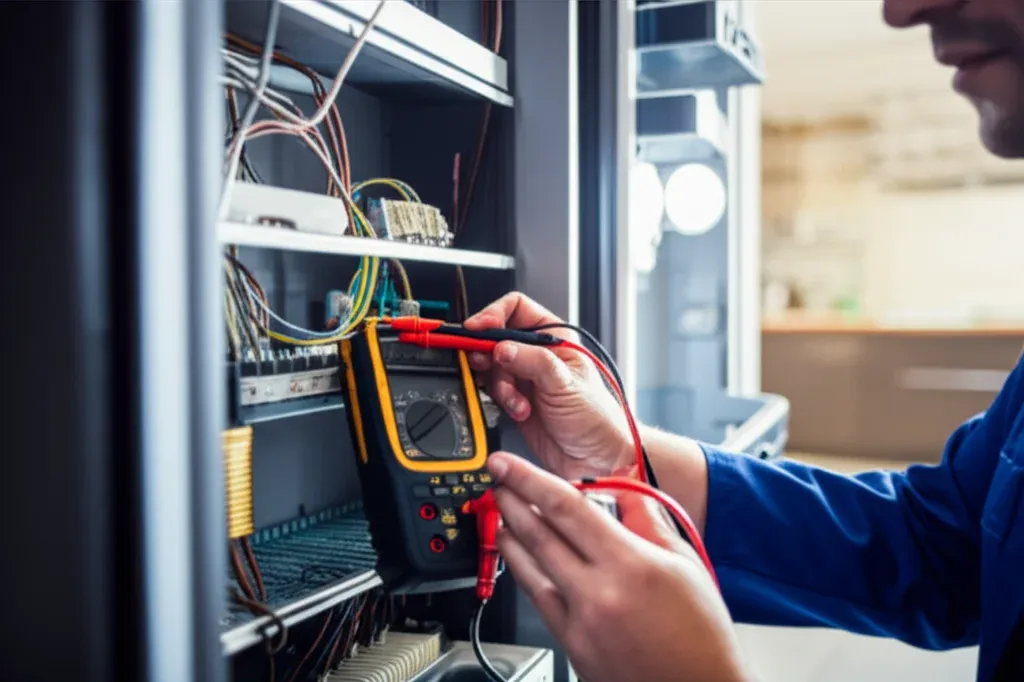
What a technician measures is what the bin cannot tell you: the actual fill volume caught over a cycle, inlet pressure at the valve with a gauge on it, and cycle timing checked against the sequence the series is meant to run. Those three readings usually settle the argument in a single visit.
The service call is $95. On the pricing side, an ice maker, water valve or supply line repair runs $290 to $660 depending on which of them turns out to be at fault. We work across Newton and take these calls regularly in Oak Hill, Belmont and Newton Highlands. Use the phone number, or the booking link; both sit at the head of this page.
Still asked on the phone
Does an aftermarket filter cartridge matter?
It can. A cartridge that fits is not necessarily a cartridge that flows, and flow rate is the specification the ice cycle actually depends on. If cube quality dropped within a few weeks of a cheaper cartridge going in, put a factory-approved part back and watch two days of production before blaming anything inside the appliance.
Should I throw away the first batch after a filter change?
Yes, discard the first bin. A new cartridge traps air, and the earliest cubes through it are often misshapen or oddly milky simply because the line has not settled. Run the dispenser for a while as well. Judge the change on what appears after a full day, not on the handful produced in the first hour.
Is it worth fitting a whole-house softener for this?
Rarely, if ice is the only complaint. Softening treats an entire house to solve something a correctly specified cartridge and an unrestricted supply line usually handle by themselves. If you already have scale trouble elsewhere in the plumbing, that is a separate discussion to have with a plumber, and not one we would push you towards.