Service area · Winchester
Winchester
Winchester calls tend to divide by elevation. Down on the flat streets the equipment that fails is usually in a basement that has been wet at some point; up on the hill it is the main kitchen cabinet, and the difficulty is reaching it.
Low ground
What standing water leaves behind in a refrigerator
On an undercounter unit or a garage freezer, everything that matters electrically is at the bottom: the compressor, the start components, the condenser and its fan, and on many cabinets the control itself. Water that came up an inch and went away again did not necessarily kill any of it on the day. It leaves corrosion on terminals, a fan bearing full of grit, and a control that works until it does not.
A unit like that gets inspected before it is energised, not after. Terminals, the fan by hand, the state of the condenser, and continuity where it matters. The cheap outcome is a fan motor and a clean-up; the expensive outcome is worth knowing about before you plug it back in and find out.
High ground
Column runs in a renovated older house
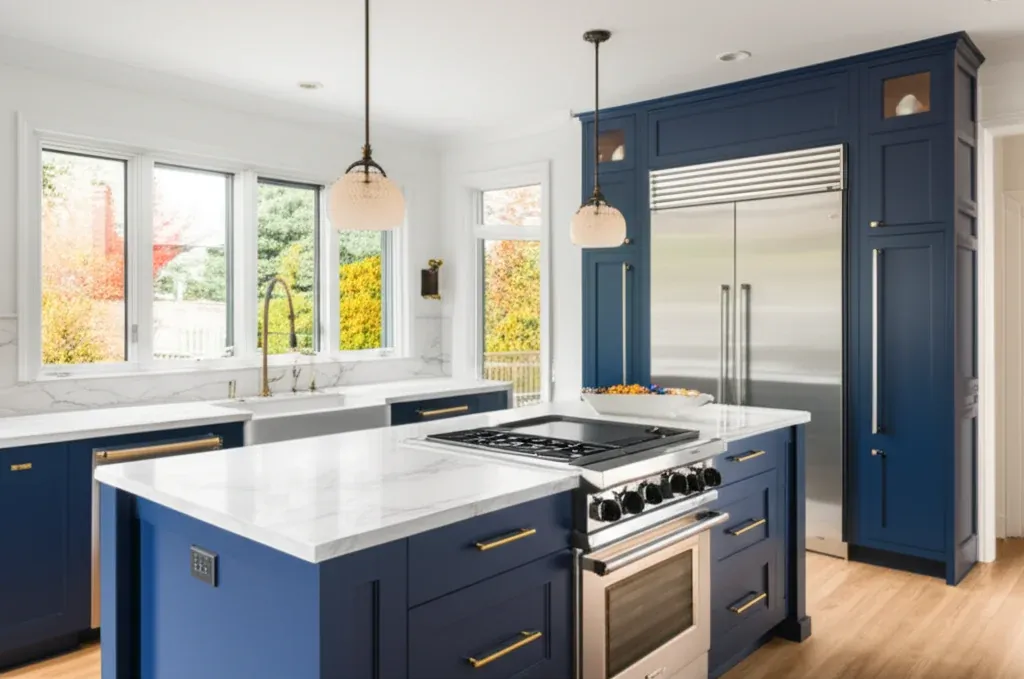
The kitchens on the hill are mostly newer than the houses around them, which means a modern column or a paired column-and-freezer set into joinery that was made to measure. Clearance at the top grille is typically the tightest dimension in the whole installation, and it is the first thing to get blocked when a cabinet is refinished or a moulding is added.
Diagnosis therefore starts outside the appliance: air in at the bottom, air out at the top, nothing in the way of either. Only then are compartment temperatures logged against a probe, the evaporator looked at for where the frost is and where it is not, and the defrost circuit taken through a cycle.
Before you ring
Four things that decide whether this is one visit or two
Ten minutes on the phone is what determines which parts ride out on the van, and there is nothing clever about it — it is four pieces of information that are all in the kitchen with you.
Have these to hand
- Model and serial from the plate, which on most built-ins is inside the fresh food compartment on the upper left wall
- What the display is doing: a code, an alarm, blank, or normal while the temperature is wrong
- When it last held temperature properly, and what changed around then
- Whether the unit is panel-ready or stainless, and whether the floor runs under it or up to it
Winchester callouts
What we get asked for here
- Refrigerator repair Warm compartment, alarms, or a cabinet that runs constantly
- Freezer repair Frost, a stalled defrost circuit, or drawers frozen shut
- Wine storage repair Zone drift, condensation and door seals
- Everything we repair The four repairs, how a visit works and what the bands are
Nearby
5out of 5
After a Winchester callout
From 860 reviews of this workshop.
Paired columns on the hill and only one was cooling. The dead one had lost its charge at a corroded joint. He was honest about the odds at that age.
Yvette S. · Belmont
Musty smell and damp inside even though the display looked normal. The drain pan had cracked and the coil was sweating onto the base. New pan, a full cleanout, and the smell has gone.
Lorna B. · Oak Hill
Production had slowed to a trickle. The filter had never been changed since we bought the house. Replaced, line flushed, and it came back in two days.
Theo N. · Belmont
Tell us what the panel is showing
Ten minutes on the phone with the model number decides which parts ride out with the van. The service call is flat $95 and it comes off the repair.
What repairs run to
Ranges, not quotes
These are the bands most jobs land in once the diagnosis is done. The figure you are given on the day is a fixed quote for your cabinet, and no work starts until you have agreed to it.
- Door gasket or seal replacement$270–$800
- Evaporator or condenser fan motor$300–$620
- Defrost heater, thermostat or sensor$310–$720
- Ice maker, water valve or supply line$290–$660
- Electronic control board$490–$880
- Compressor or sealed-system repair$1,020–$2,220
Flat $95 service call covering the visit and full diagnosis, credited against the repair once you approve it.