Brand · GE Monogram
Monogram built-in refrigeration
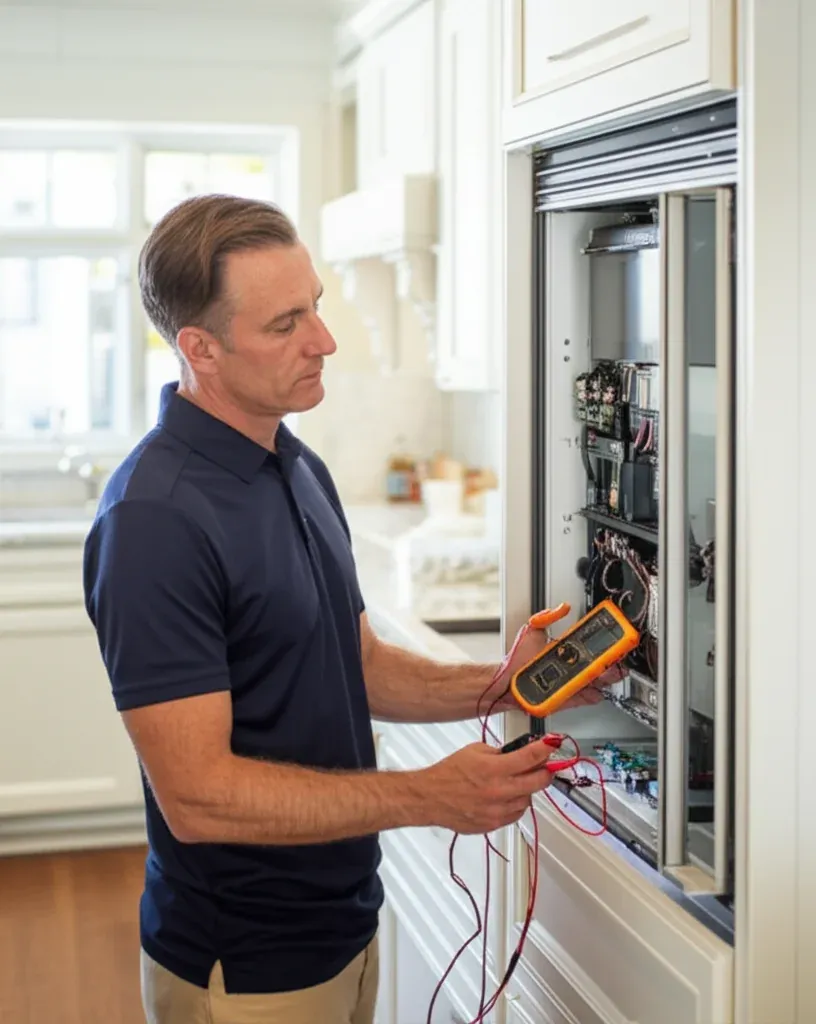
Behind a panel-ready door a Monogram and a Sub-Zero column look like the same appliance. They are not, and the most common complaint about both — the fridge is warm, the freezer is fine — means something almost opposite on each.
The architecture
One evaporator and a damper, not two sealed systems
A Sub-Zero column runs two independent sealed systems, so a warm fresh food side and a hard freezer usually means the fresh food system itself is in trouble. Most Monogram built-in refrigeration makes all of its cold in one place and moves it: the evaporator lives on the freezer side, and the fresh food compartment gets a share of that air through a damper and a duct.
That single design decision changes the whole diagnosis. On a Monogram, the same complaint points first at the damper being stuck or losing its control signal, then at the evaporator fan not moving air, then at frost building in the duct or across the coil so that there is nothing to move, and only then at anything to do with the sealed system.
Working a Monogram as though it had two systems is how a damper motor becomes a compressor quote. Working a Sub-Zero as though it had one is how a genuinely failed system gets sent away with a clean condenser.
Read in this sequence
- Damper position and drive, with the compartment temperatures logged rather than glanced at
- Evaporator fan behaviour with the door switches defeated, listening for a motor that spins but moves nothing
- Frost pattern across the coil and at the duct outlet — where it is tells you which of the three it is
- Defrost heater and its bimetal, taken through a full termination
- Thermistor resistances at the harness, checked against the temperature actually present
- Control board last, and only once the four above have been cleared
Sensors and control
Monogram trusts its thermistors, so the technician should not
These cabinets do not have a mechanical thermostat making the decisions. Thermistors report compartment and evaporator temperatures to the board, and the board decides everything from there — how long the compressor runs, when a defrost is called, whether the damper opens.
A thermistor that has drifted rather than failed outright is therefore one of the more expensive faults to misread. The cabinet behaves oddly but consistently: it runs and runs and will not reach setpoint, or it never calls a defrost and quietly ices up until the airflow stops. The display shows nothing unusual, because as far as the board is concerned nothing is unusual.
The check is resistance at the harness compared against the real temperature at the probe, which takes minutes and settles the question. Boards do fail on these units, and when one has, it gets replaced. It is simply not the first thing to reach for.
The water side
Fill tubes, inlet valves and a door that has been opened a lot
The ice maker complaints on these units cluster tightly. A fill tube that freezes at its tip will refill a little less each cycle until it stops; the maker is fine, the tube and whatever let it get cold are not. The inlet valve is the other regular, and a valve that leaks past slowly gives you a block of fused ice in the bin rather than an obvious flood.
On the side-by-side cabinets there is a third one worth naming: the wiring harness that crosses the door hinge flexes every time the door opens, and after enough years a conductor inside the sheath breaks. Dispenser dead, door lights out, sometimes an intermittent that comes back when the door is at a particular angle. It looks electronic and it is mechanical.
Scope, and what it is worth
Refrigeration only, and parts you can still get
This is a refrigeration workshop. Monogram refrigerators, freezers, undercounter cabinets and wine storage are work we take; Monogram ranges, wall ovens, hoods and dishwashers are not, and you are better served by someone whose van carries those parts.
The repair economics are usually kinder here than on some built-ins. Fans, valves, thermistors, dampers, heaters and boards for these cabinets are generally still obtainable, so the common faults are ordinary repairs rather than a hunt. Factory-approved parts are used where they exist. As with any cabinet of a certain age, a sealed-system failure is a different conversation, and you will get it straight.
We are an independent workshop with no affiliation to GE Appliances or the Monogram brand, and no part in anyone else’s cover arrangements.
Related work
The repairs these cabinets come in for
- Refrigerator repair Damper, airflow, defrost and controls, read in order
- Freezer repair Frost that keeps returning, and defrost circuits that stall
- Ice maker repair Fill tube, inlet valve and compartment temperature
- Everything we repair How a visit works and what repairs run to
Elsewhere on the site
Sub-Zero, Wolf and Monogram are trademarks of their respective owners. This is an independent repair workshop and is not affiliated with any of them.
4.9out of 5
What people said about the workshop
From 1554 reviews of this workshop.
The arm kept cycling with nothing coming out. The supply line under the floor had a slow kink from an old install. He rerouted it and the bin was full again in a day and a half.
Paloma R. · Newton Centre
Interior lights flickered for a month and then the display went blank. Loose harness at the hinge where the wires flex every time you open it. He repinned the connector instead of selling me a board.
Desmond A. · Oak Hill
Musty smell and damp inside even though the display looked normal. The drain pan had cracked and the coil was sweating onto the base. New pan, a full cleanout, and the smell has gone.
Lorna B. · Oak Hill
Tell us what the panel is showing
Ten minutes on the phone with the model number decides which parts ride out with the van. The service call is flat $95 and it comes off the repair.
What repairs run to
Ranges, not quotes
These are the bands most jobs land in once the diagnosis is done. The figure you are given on the day is a fixed quote for your cabinet, and no work starts until you have agreed to it.
- Door gasket or seal replacement$270–$800
- Evaporator or condenser fan motor$300–$620
- Defrost heater, thermostat or sensor$310–$720
- Ice maker, water valve or supply line$290–$660
- Electronic control board$490–$880
- Compressor or sealed-system repair$1,020–$2,220
Flat $95 service call covering the visit and full diagnosis, credited against the repair once you approve it.